

It makes me happy to see that others enjoy what I enjoy…

Vicente Molina Foix once wrote about riding in the Madrid Metro:
“I like to see the juxtaposition of various skin colors, and hear the melody of incomprehensible languages, as the train of the future approaches on the rails of life.”
Here is a man at ease with one of the biggest changes to Spanish life in the last few decades. He realises that this country is becoming one great human paella with a tasty mixture of ingredients.
Those close-minded people who make the effort to appreciate the benefits of migrants from across our odd little fragile planet will be doing little more than opening their senses.
The continuing mixing of cultures is one of the great success stories of human history and closing ourselves off from the results of migration is as pointless as trying to ignore some exotic music from a neighbour’s radio drifting into our ears.
Migration in Europe, Britain, the USA (and elsewhere) will not end, though it has fluctuated somewhat in the last decades due to the Great Recession in 2008 —one that is in many ways yet to end.
The human animal that adapts best to changes in its surroundings will continue to be the one that thrives.
As shown in the news this week, a Syrian man who moved to the UK as a refugee has gone from being unable to speak English to qualifying as a secondary school teacher. He wanted his story to inspire students.
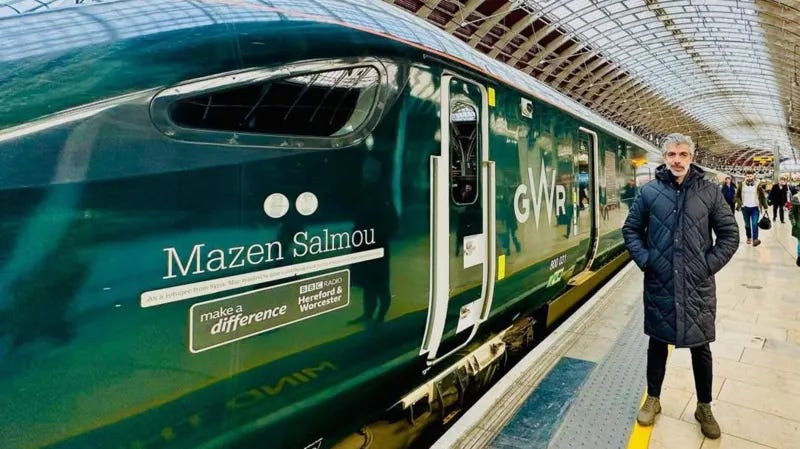
“Maz Salmou, who arrived in Worcestershire in 2019 with no money, said his personal safety was in danger in his home country, with the move facilitated under the United Nations resettlement programme.
The following year, a train was named after him for services to the community in the UK during the Covid pandemic, under a scheme run by Great Western Railway in conjunction with BBC Local Radio.
He said that following his arrival in the UK he had set three goals – improving his English, pursuing higher education after coming with a degree in fine arts and “trying to give something back”.
“I would like to take this opportunity to thank the British government and also British people, in particular Bromsgrove, people of Bromsgrove… for giving me the chance to live and settle in this country,” he said.
“I was trying to give something back, getting about in voluntary work. I was delivering medicines to elderly people in Bromsgrove, my neighbours as well.”
Asked about studying at the University of Worcester, Mr Salmou admitted it had been a tough course.
“The truth must be told. Without my tutors’ and lecturers’ support I couldn’t have done it.
“They did [a] really excellent job. They were not just experts. They were really caring people.”
“…Asked what the future holds, he said: “I’m trying my best actually to give some of my experience, my knowledge to [the] younger generation.
“I was telling my students at schools when I was delivering lessons, ‘Look guys, I came here with no English, now I’m teaching you English, so you could do everything you want…. just push yourself’.”
He added he would now also focus on doing a PhD and probably write a book.
 Brett Hetherington